ABLE’s Custom Converting Solutions for EV Batteries and Advanced Battery Applications
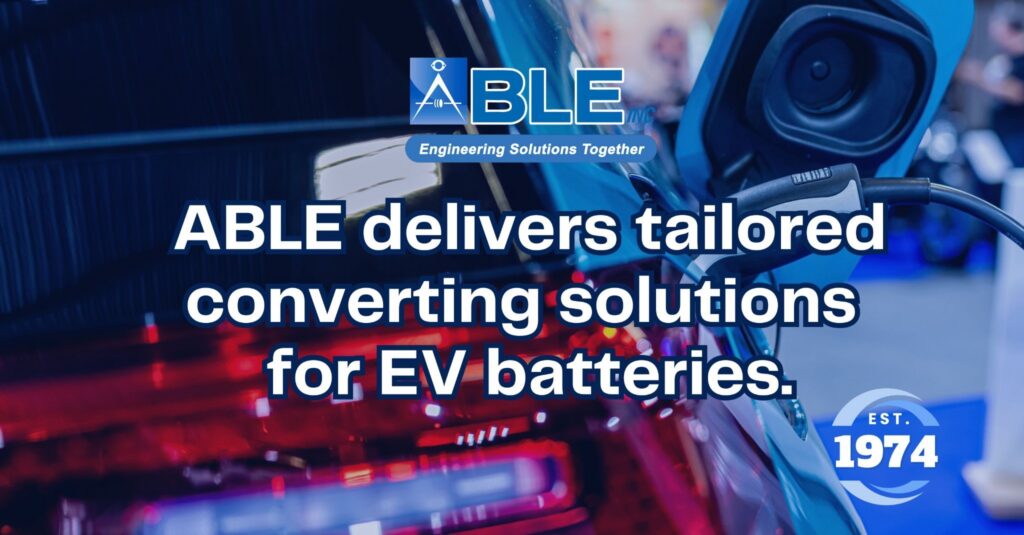
As EV battery systems become more compact, powerful, and sophisticated, manufacturers must solve a range of engineering challenges inside the battery pack — from thermal management and electrical insulation to EMI shielding, sealing, cushioning, and component attachment.
These requirements place increasing demands on the materials used around battery cells, modules, packs and associated electronics.
For battery and EV manufacturers, the challenge is not simply finding a material with the right properties. Materials often need to be precision converted into custom shapes, thicknesses and configurations that fit the geometry and performance requirements of the final assembly.
This is where ABLE Industrial Products supports battery and EV manufacturers.
With more than 50 years of custom converting experience, ABLE provides precision converting solutions for applications involving thermal management, electrical insulation, shielding, sealing, adhesives, compression, and protection.
Why Material Converting Matters in EV Battery Design
An EV battery pack contains hundreds or thousands of individual components that must work together reliably.
Materials used within the battery system may need to:
- Transfer or dissipate heat
- Electrically isolate high-voltage components
- Reduce electromagnetic interference
- Fill gaps between components
- Cushion cells against vibration and movement
- Seal battery enclosures against environmental exposure
- Provide flame or thermal barriers
- Bond components together
- Maintain dimensional consistency during assembly
Many of these materials begin as rolls, sheets, films, foams, pads or other raw formats.
The finished battery component, however, may need to be a highly specific shape.
Precision converting bridges that gap.
Using processes such as die cutting, laminating, slitting, laser cutting, water-jet cutting and custom adhesive application, ABLE can transform advanced materials into application-specific components for battery and EV systems.
Key Battery and EV Applications for Custom Converting
ABLE supports several critical areas of EV battery design.
1. Thermal Management for EV Batteries
Thermal management is one of the most important considerations in modern battery engineering.
Battery cells generate heat during charging, discharging and high-power operation. Maintaining an appropriate operating temperature helps support battery performance, reliability and service life.
As battery systems become more compact and energy dense, effective heat transfer becomes increasingly important.
Where do thermal interface materials fit into EV batteries?
Thermal interface materials (TIMs) help transfer heat between components where microscopic air gaps would otherwise reduce thermal conduction.
Depending on the battery architecture, thermal materials may be used between:
- Battery cells and cooling plates
- Modules and thermal management systems
- Heat-generating electronic components and heat spreaders
- Battery housings and cooling structures
- Power electronics and thermal management components
ABLE can precision-convert thermal interface materials into custom gap pads, thermal pads and other application-specific components.
ABLE’s existing EV solutions include thermal interface materials and gap fillers designed to support heat dissipation within battery systems.
Why precision matters
A thermal interface material has to fit the intended gap.
If a pad is too thick, it may create excessive compression. If it is too thin, it may not adequately fill the gap.
Dimensional consistency therefore matters when designing thermal components for battery assemblies.
2. Electrical Insulation for High-Voltage Battery Systems
EV battery packs operate at high voltages, making electrical insulation a critical design consideration.
Insulation materials can help prevent unintended electrical contact between components and provide separation between conductive elements.
ABLE converts insulation materials into application-specific components for battery and EV systems, including:
- Electrical insulation films
- Dielectric barriers
- Insulating pads
- Die-cut insulation components
- Custom-shaped separators
- Adhesive-backed insulation components
ABLE’s current EV applications portfolio specifically identifies electrical insulation films and dielectric barriers as battery solutions.
The material and finished geometry must be selected according to the voltage, temperature, mechanical and environmental requirements of the application.
3. EMI and RFI Shielding
As EVs become increasingly electronic, electromagnetic compatibility becomes another important engineering consideration.
Battery systems contain high-voltage electrical components, power electronics, sensors, control systems and communication electronics.
Unwanted electromagnetic interference can affect electronic systems if it is not properly managed.
ABLE provides precision converting for materials used in EMI/RFI shielding applications, helping manufacturers produce components in the dimensions and configurations required for their assemblies.
Potential applications include:
- Battery electronics
- Battery management systems
- Power electronics
- Inverters
- Charging systems
- Electronic control modules
- High-voltage electrical assemblies
ABLE’s EV battery applications include EMI shielding and conductive tapes as part of its broader battery converting solutions.
4. Battery Cell Assembly and Adhesive Applications
Adhesives play an important role throughout battery manufacturing.
Depending on the battery architecture, adhesive materials may be used for:
- Component attachment
- Insulation
- Cell assembly
- Bonding
- Sealing
- Thermal management
- Protection
- Structural support
ABLE can convert adhesive tapes and films into custom components using processes such as die cutting and laminating.
For example, an adhesive-backed component may need a specific shape that allows it to be positioned accurately during automated or manual assembly.
This is where converting becomes more than simply cutting material.
The converter must consider part geometry, adhesive performance, liner configuration, application method, and manufacturing tolerances.
5. Battery Pack Sealing and Gasketing
Battery packs need protection from environmental conditions while maintaining the required enclosure and assembly performance.
Gaskets, seals and foam components can be used around battery housings, covers, access panels and other interfaces.
ABLE provides custom converting for:
- Battery enclosure gaskets
- Foam seals
- Die-cut sealing components
- Adhesive-backed gaskets
- Gap-filling materials
- Environmental seals
These components can help address requirements involving moisture, dust, vibration and dimensional variation.
The right gasket material depends on the enclosure design, gap, compression requirements and environmental exposure.
6. Compression Pads and Battery Cushioning
Battery cells and modules can experience mechanical movement and vibration during vehicle operation.
Compression pads and cushioning materials can help accommodate dimensional changes and provide mechanical protection within the battery assembly.
This is particularly relevant when manufacturers need to balance:
Protection + compression + dimensional stability + available space
ABLE can precision-convert foam and elastomeric materials into custom pads, cushions and other battery components.
The finished geometry can be designed around the requirements of the battery module or pack rather than forcing the application to conform to an off-the-shelf shape.
7. Flame-Retardant and Thermal Barrier Materials
Battery safety is another major consideration in EV design.
Manufacturers are evaluating materials and component designs that can help manage heat and provide additional protection within battery systems.
Flame-retardant and thermal barrier materials can potentially be incorporated into battery assemblies depending on the application and required specifications.
ABLE’s current EV applications page includes flame-retardant materials among its battery solutions.
Material selection should always be based on the specific thermal, electrical, mechanical and regulatory requirements of the battery system.
8. Custom Lamination for Battery Components
Some battery components require multiple material layers to perform different functions.
For example, a component may need:
- A structural layer
- An insulating layer
- An adhesive layer
- A protective film
- A thermal or cushioning layer
Custom lamination allows multiple materials to be combined into a single engineered component.
ABLE’s custom laminating capabilities can combine materials such as films, foams, rubber and foils with pressure-sensitive adhesives and other substrates.
This can simplify assembly by creating a multi-layer component that is ready for installation.
Precision Die Cutting for EV Battery Components
Precision die cutting is a key converting operation for creating repeatable parts for batteries and EVs. The process enables materials to be cut with a specific shape and dimension and facilitates the same production with various parts.
A range of different battery parts can be produced by use of ABLE’s rotary die cutting and flatbed die cutting. All types of die-cut parts can be made from insulating materials, adhesive-backed materials and components, protective pads, gaskets, seals and other functional parts depending on the material and design.
Precision of material selection and conversion is especially vital for batteries. Parts can be required to perform a specific function under extreme environmental conditions in a small assembly. Precision converting can aid manufacturers in the consistent fit, placement and material coverage.
ABLE can also combine multiple materials through laminating, creating a multi-functional converted part. This can be beneficial when more than one property is needed in an application, such as insulation, cushioning, adhesion or protection.
Why Choose ABLE for Battery and EV Converting?
Cutting material to shape is not enough for battery and EV applications. Manufacturers require a converting partner that is fully aware of the significance of material performance, dimensional accuracy, repeatability, and quality throughout the manufacturing process.
ABLE offers custom converting solutions to meet each customer’s material, design, and application needs. It can be used for rotary die cutting, flatbed die cutting, kiss cutting, laminating, slitting and spooling, skiving, water jet cutting, laser processing, and routing.
ABLE also collaborates with a variety of advanced materials and material partners to enable solutions where more specialized foams, films, adhesives, thermal materials, and more are needed. The prototyping feature can assist customers in trialing designs and progressing from design to production.
Another key factor for components in challenging applications is quality. ABLE has a quality management system with Certifications: ISO 9001:2015, ISO 13485:2016, and AS9100:D. It can also be manufactured in a cleanroom environment for applications that demand controlled manufacturing.
ABLE integrates material knowledge, precision converting, prototyping, and quality-oriented manufacturing to empower manufacturers with the ability to create custom components for emerging battery and EV technology.
Supporting the Next Generation of Battery and EV Technology
The continued growth of electric vehicles and advanced battery systems is creating new requirements for materials and precision-engineered components. From insulation and electrical isolation to cushioning, sealing, protection, and thermal management, custom converted materials can play an important role throughout battery assemblies.
ABLE’s custom converting solutions provide manufacturers with the flexibility to develop components around their specific application requirements. With precision die cutting, laminating, prototyping, and other advanced converting capabilities, ABLE can support the development and production of components for EV batteries and other advanced battery applications.
As battery technologies continue to evolve, working with an experienced converting partner can help manufacturers address complex material and component requirements while maintaining precision, consistency, and quality.
Ready to develop custom components for your EV or advanced battery application? Contact ABLE today to discuss your material and converting requirements.
References:
https://able123converting.com/blog/precision-converting-for-high-performance-ev-batteries-with-able/
https://able123converting.com/blog/advanced-ev-battery-manufacturing-with-ables-precision-solutions/