
Thermal Interface Materials for EV Batteries: Enhancing Performance, Safety & Reliability with ABLE
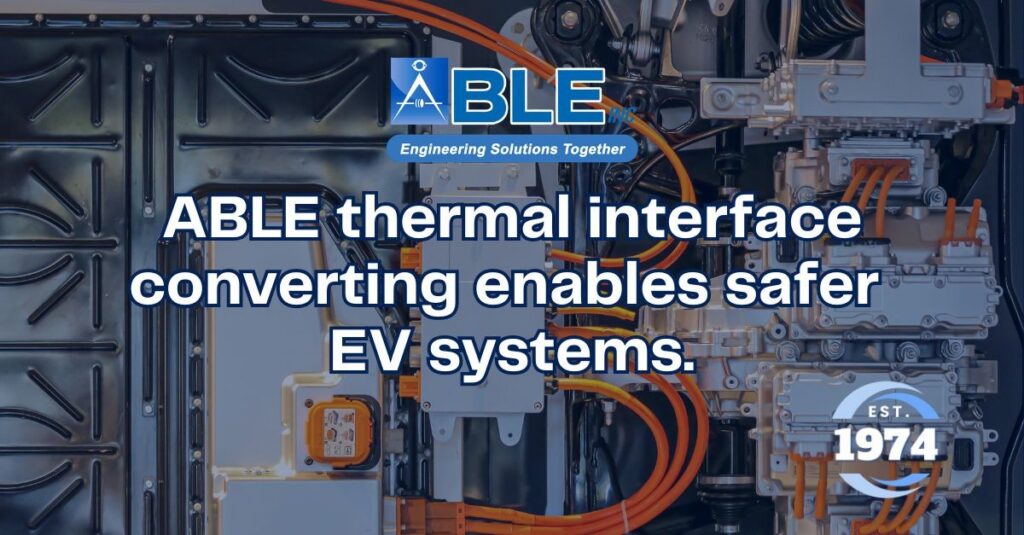
Electric vehicles (EVs) are driving the future of transportation, but behind every high-performing EV is a battery system that must operate safely and efficiently under demanding conditions. As battery technologies become more powerful and compact, managing heat inside EV battery packs has become one of the industry’s biggest engineering challenges.
This is where thermal interface materials (TIMs) play a critical role.
Thermal interface materials help regulate heat transfer between battery components, preventing overheating and supporting long-term battery performance. Combined with ABLE’s precision converting expertise, these materials can be transformed into custom-engineered solutions tailored for advanced EV battery applications.
What Are Thermal Interface Materials?
Thermal interface materials (TIMs) are designed solutions to enhance thermal transfer between EV battery elements like cells, cooling plates, and battery enclosures. They fill the minute spaces between the surfaces with more thermally conductive materials, which substantially enhance heat flow.
The elimination of the trapped air minimizes thermal resistance, which results in stable operating temperatures, efficiency gains, and avoidance of heat stress to battery systems.
How Thermal Interface Materials Work
During charging, discharging, and during continuous driving cycles, EV batteries generate heat. Without proper management, this heat can cause inefficiency, accelerate degradation, and even pose safety hazards.
Thermal interface materials serve to establish an efficient heat-conducting path between heat-producing devices and cooling systems. This ensures uniform heat distribution and heat removal from the battery cells to avoid hot spots and to keep a uniform temperature throughout the battery.
Types of Thermal Interface Materials Used in EV Batteries
Different EV battery architectures require different thermal solutions depending on performance needs and design constraints:
- Thermal Gap Fillers
Gap fillers are soft, compressible materials that fill uneven spaces between components.
Benefits include:
- Excellent heat transfer
- Vibration absorption
- Flexible integration into battery assemblies
- Thermal Pads
Thermal pads provide consistent thermal conductivity and are commonly used in battery modules and power electronics.
Key advantages:
- Easy installation
- Reliable thermal performance
- Electrical insulation support
- Thermally Conductive Adhesives
These materials combine bonding capabilities with heat transfer performance.
They help:
- Secure components
- Improve thermal management
- Reduce assembly complexity
- Phase Change Materials
Phase change materials adjust to temperature variations and improve thermal contact during operation. These are often used in high-performance EV systems requiring efficient heat dissipation.
Each type is selected based on conductivity, compression behavior, durability, and compatibility with EV battery design requirements.
Why Thermal Management Is Critical for EV Safety
Proper thermal management is crucial for ensuring battery safety, efficiency, and reliability while operating EVs. Battery cells operate best in a specific temperature range; too hot or too cold batteries will not perform efficiently, have shorter battery life, and will cause more thermal runaway issues.
Poor thermal management can lead to:
- Reduced battery capacity
- Faster material degradation
- Uneven cell temperatures
- Thermal propagation risks
Proper EV battery cooling helps extend battery lifespan, improve charging performance, and maintain a consistent driving range. Advanced thermal interface materials are beginning to play an important role in EV systems to ensure safe operation as battery power increases and systems become smaller.
Effective thermal management also supports:
- Faster charging performance
- Longer battery life
- Improved energy efficiency
- Enhanced passenger safety
The Role of Custom Converting in Thermal Management Solutions
The best thermal materials are exactly engineered to the specific geometry of EV battery designs. Custom converting guarantees proper shaping, thickness, and positioning of the material for maximum thermal efficiency.
ABLE provides advanced converting processes, including:
- Die cutting – Allows for high-precision cutting of thermal materials into complex shapes needed for EV battery configurations.
- Precision slitting – A slitting machine for uniform material width to ensure uniformity in large-scale battery production.
- Laminating – Creates multi-layer structures with improved thermal conductivity and performance.
- Kiss cutting – Enables easy peel and place application of thermal components to increase speed and efficiency.
- Cleanroom manufacturing capabilities – Assure contamination-free manufacturing for high-performance EV battery applications.
These processes allow thermal materials to be integrated efficiently into battery assemblies while maintaining consistency, reducing waste, and improving production scalability.
ABLE’s Expertise in Thermal Interface Material Converting
ABLE has a long history in precision manufacturing and possesses a depth of knowledge in the development and execution of advanced thermal interface material to application-ready components for EV battery systems. We create products from advanced materials like thermal pads, insulating films, conductive layers, and specialty foams for critical automotive applications.
ABLE guarantees each converted part is dimensional, thermally efficient and durable. Our knowledge can be applied to EV manufacturers to improve performance and safety for battery platforms.
How ABLE Supports EV Battery Manufacturers
As EV technologies evolve, battery systems are becoming more compact and sophisticated. Manufacturers require thermal management solutions that are:
- Reliable
- Lightweight
- Precise
- Scalable for production
ABLE supports these requirements by delivering:
- Precision-converted thermal materials
- Consistent manufacturing quality
- Custom-engineered battery components
- Efficient material utilisation
This helps improve battery safety, thermal performance, and manufacturing efficiency.
Applications of Thermal Interface Materials in EV Systems
Thermal interface materials are employed in many electric vehicle applications, such as:
Battery Packs
Managing heat between cells and modules
Power Electronics
Supporting cooling in inverters and converters
Charging Systems
Helping regulate temperatures during fast charging
Battery Management Systems (BMS)
Protecting sensitive electronics from heat buildup
Conclusion
As electric vehicle technology continues to advance, thermal management has become a critical factor in battery performance, efficiency, and safety.
Thermal interface materials play a vital role in controlling heat, protecting battery systems, and supporting long-term reliability in modern EV applications.
Combined with ABLE’s precision converting expertise, these materials can be transformed into high-performance thermal solutions tailored for complex EV battery systems.
Contact ABLE today to discover how precision-converted thermal interface materials can enhance your EV battery performance, safety, and reliability!
Frequently Asked Questions
What are thermal interface materials?
Thermal interface materials are engineered materials that improve heat transfer between electronic components and cooling systems.
Why are thermal interface materials important in EV batteries?
They help regulate battery temperatures, improve efficiency, reduce overheating risks, and support long-term battery reliability.
What types of thermal interface materials are used in EVs?
Common types include thermal pads, gap fillers, thermally conductive adhesives, and phase change materials.
How do thermal interface materials improve EV safety?
They help prevent excessive heat buildup and reduce thermal propagation risks inside battery systems.
What is custom converting in EV manufacturing?
Custom converting involves transforming raw materials into precision-engineered components tailored for EV battery and electronics applications.
https://able123converting.com/blog/ables-thermal-interface-management-emi-rfi-shielding-solutions/
https://able123converting.com/materials/thermal-interface-material-emi-rfi-shielding/