Environmental Gasketing for Drones and UAVs: Choosing the Right Silicone Foam Seal
Drones and unmanned aerial vehicles (UAVs) often face conditions that can challenge their internal components. Moisture, dust, temperature fluctuations, and repeated outdoor use can all affect sensitive electronics housed inside compact enclosures.
A properly designed environmental gasket helps protect these components by creating a seal between enclosure surfaces. However, choosing the right gasket material requires more than finding a foam that fits the available space. Engineers must consider the enclosure design, compression requirements, environmental exposure, and operating conditions.
kSil™ V-0 NG Soft Silicone Foam is one material option to consider for environmental gasketing applications where a soft, conformable seal is needed. With the right material selection and custom converting process, manufacturers can develop gasket components suited to their drone and UAV designs.
Why Environmental Sealing Matters in Drone and UAV Design
Drone enclosures house important electronics, sensors, batteries, communication systems, and other components that need protection during operation.
Unlike equipment used exclusively indoors, drones may encounter changing weather and environmental conditions. Even relatively small gaps around enclosure covers, access panels, and component interfaces can create potential entry points for dust and moisture.
Common environmental sealing challenges include:
- Moisture exposure: Rain, humidity and condensation can create risks for sensitive electronic components.
- Dust and debris: Particles can enter through enclosure gaps and affect internal components.
- Temperature fluctuations: Changes in operating and ambient temperatures can influence gasket compression and material behaviour.
- Limited enclosure space: Compact drone designs leave less room for sealing materials.
- Repeated opening and closing: Maintenance and battery access can place additional demands on enclosure seals.
These challenges make gasket design an important consideration when developing reliable drone and UAV systems.
What Is kSil™ V-0 NG Soft Silicone Foam?
kSil™ V-0 NG Soft Silicone Foam is a silicone foam material featured for environmental gasketing applications where a soft, conformable seal is required.
Its potential role in drone and UAV designs is to help create a sealing interface between enclosure components, particularly where the gasket must accommodate the available gap and maintain contact between mating surfaces.
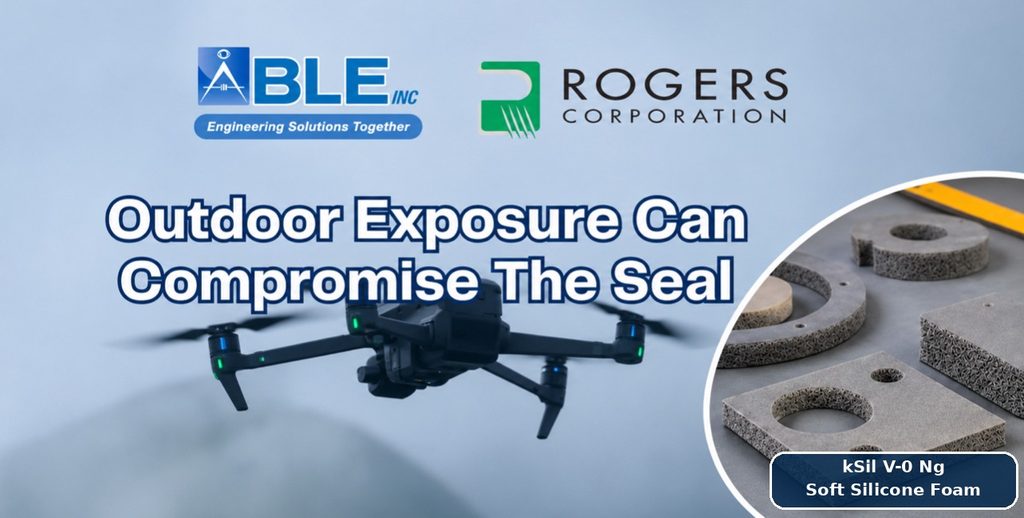
The product graphic highlights environmental protection against dust and moisture, with outdoor electronics and compact enclosures identified as relevant applications.
Material selection should always be based on the exact grade’s technical documentation and the requirements of the finished assembly. Engineers should confirm the applicable compression characteristics, thickness options, temperature limits and environmental performance before specifying the material.
Key Considerations When Selecting Silicone Foam for UAV Gaskets
The best gasket material depends on the design and operating conditions of the enclosure. Before selecting kSil V-0 NG Soft or another silicone foam, engineers should evaluate several factors.
1. Enclosure Gap and Gasket Thickness
The available gap between enclosure surfaces is one of the first things to establish.
A gasket that is too thick may require excessive compression during assembly. One that is too thin may not make sufficient contact with the mating surfaces.
Measuring the enclosure gap helps determine the appropriate gasket thickness and geometry.
2. Compression Requirements
A gasket needs to compress sufficiently to create contact between the sealing surfaces without being compressed beyond its intended operating range.
Engineers should consider:
- Available compression space
- Required closure force
- Gasket compression characteristics
- Enclosure design and fastening method
- Expected changes during the product’s service life
A soft silicone foam may be worth evaluating where a conformable seal is needed, but its suitability depends on the actual compression requirements and the product’s technical specifications.
3. Dust and Moisture Protection
The purpose of an environmental gasket is to help limit the entry of unwanted contaminants through enclosure interfaces.
For drone and UAV applications, engineers should identify the level of protection required and the conditions the enclosure will encounter.
If the finished design requires a specific ingress protection rating, such as IP67 or IP68, the complete enclosure assembly must be tested against the relevant requirements. Selecting a gasket material alone does not establish an IP rating.
4. Temperature and Outdoor Exposure
Drones may operate in environments with changing temperatures and varying levels of sunlight, humidity, and weather exposure.
The selected material should be evaluated against the expected operating temperature range and environmental conditions.
Engineers should also consider whether repeated temperature changes could affect gasket compression, flexibility or long-term sealing performance.
5. Enclosure Geometry and Available Space
Drone enclosures often have complex shapes, limited internal space and multiple component interfaces.
The gasket may need to follow corners, curves, openings and irregular profiles while maintaining consistent contact with the enclosure.
Custom-converted gasket shapes can help manufacturers match the sealing component to the actual enclosure geometry.
Why Custom-Converted Silicone Foam Gaskets Matter
Selecting a suitable foam is only one part of the process. The material also needs to be converted into a component that fits the design.
Custom converting can help manufacturers produce gasket parts with specific dimensions, profiles and configurations.
Depending on the material and design requirements, converting processes may include:
- Precision die cutting: Producing repeatable gasket shapes, holes and cut-outs.
- Water jet cutting: Creating custom profiles for suitable foam materials and part geometries.
- Prototyping: Evaluating gasket fit, dimensions and assembly compatibility before production.
- Material preparation: Converting supplied materials into formats suitable for manufacturing.
These processes can help address the practical challenges of fitting a gasket into compact drone and UAV enclosures.
How ABLE Supports Drone and UAV Environmental Gasketing
As a Rogers Preferred Converter, ABLE works with engineered materials to support application-specific component requirements. Our custom converting capabilities include precision die cutting, water jet cutting, slitting, laminating, prototyping, and assembly.
For drone and UAV manufacturers considering kSil V-0 NG Soft Silicone Foam, ABLE can help evaluate material requirements, develop custom gasket geometries, and produce prototype parts for design evaluation.
The process starts with understanding the application:
- Review the enclosure design and available gasket space.
- Identify the required sealing performance and environmental conditions.
- Evaluate suitable material options and thickness requirements.
- Develop the gasket geometry and converting approach.
- Produce prototype parts for fit and application testing.
This helps connect material selection with the practical requirements of manufacturing and assembly.
Learn more about ABLE’s custom converting capabilities and engineered materials.
Develop the Right Environmental Seal for Your UAV Design
Reliable environmental sealing starts with understanding the enclosure, the available gap and the conditions the gasket will face.
kSil V-0 NG Soft Silicone Foam may be an option when a soft, conformable material is needed. The right choice, however, depends on the complete design and verified material specifications.
Working on an environmental sealing challenge for a drone or UAV? Contact ABLE Industrial Products to discuss material selection, custom converting and prototype gasket components for your application.